Lab 1: Find the edit by diffing the two weight files
On this page
Big thing: You will compare all 488 weight tensors (873,438,784 numbers) of base Qwen3.5-0.8B and the paper's released model bit for bit. From the weights alone, you recover the full edit: layers = [15, 19], 64 columns per layer, rank-one direction u, and strength alpha = 6.
Why it matters: When you have the weight files, you do not have to take a paper's description on faith. Tensor diffs and an SVD turn a 0.87-billion-parameter checkpoint diff into one short formula.
Time and hardware: Under a minute on CPU on sampler or trainer (no GPU needed).
Theory guide: Section 9, step 4.
Before you run: predict
Write a short guess for each question before running the script.
- Out of the 488 weight tensors in Qwen3.5-0.8B, how many differ between the base model and the released model
qwen35-p50c? - Each edited
down_proj.weightmatrix has shape1,024 x 3,584, and the edit touches64columns (64 x 1,024 = 65,536numbers). Will the file have65,536changed entries or slightly fewer, and why? - In Lab 0, the second singular value of
W' - Wwas0.0000. For the real weight change, will the second singular value be exactly zero or slightly above zero?
Run it
Connect to one of the lab VMs (sampler or trainer), activate the lab environment, and run labs/lab1_diff.py on CPU. This script does not touch a GPU.
ssh sampler
. /nvme/wsp-lab/code/scripts/env.sh && cd /nvme/wsp-lab/code
python labs/lab1_diff.py
The script compares every tensor in /nvme/wsp-lab/models/Qwen3.5-0.8B against /nvme/wsp-lab/models/qwen35-p50c, writes results/lab1/diff.json, and saves results/figures/lab1_diff.png.
What you should see
2 of 488 tensors differ (873M numbers in all):
   model.language_model.layers.15.mlp.down_proj.weight  shape [1024, 3584]
      entries changed: 65,260 of 3,670,016, all inside 64 columns (neurons)
      singular values of the change: [1.7489, 0.001, 0.0009, 0.0009] ...  rank-one share 0.999994
      fitted alpha = 6.0003; the matrix moved by 10.6%
   model.language_model.layers.19.mlp.down_proj.weight  shape [1024, 3584]
      entries changed: 64,928 of 3,670,016, all inside 64 columns (neurons)
      singular values of the change: [1.3988, 0.0009, 0.0008, 0.0007] ...  rank-one share 0.999991
      fitted alpha = 6.0002; the matrix moved by 8.1%
|cos| between the two directions: 0.849 (1 = same direction, 0 = unrelated; the SVD sign is arbitrary, Lab 3 fixes it)
wrote /nvme/wsp-lab/code/results/lab1
results/lab1/diff.json and results/edit_info.json record the exact numbers:
| Measurement | Layer 15 (down_proj.weight) |
Layer 19 (down_proj.weight) |
|---|---|---|
| Matrix shape (rows x columns) | 1,024 x 3,584 (3,670,016 entries) |
1,024 x 3,584 (3,670,016 entries) |
| Entries changed | 65,260 |
64,928 |
| Columns (neurons) containing every change | 64 |
64 |
| First 8 changed columns | 0, 2, 11, 25, 34, 35, 38, 39 |
1, 5, 8, 11, 13, 15, 17, 18 |
Top 4 singular values of W1 - W0 |
1.7489, 0.0010, 0.0009, 0.0009 |
1.3988, 0.0009, 0.0008, 0.0007 |
| Rank-one share () | 0.999994 |
0.999991 |
Fitted strength alpha |
6.0003 |
6.0002 |
| Relative matrix change () | 10.6% (0.10636) |
8.1% (0.08106) |
| Absolute cosine between and | 0.849 |
0.849 |
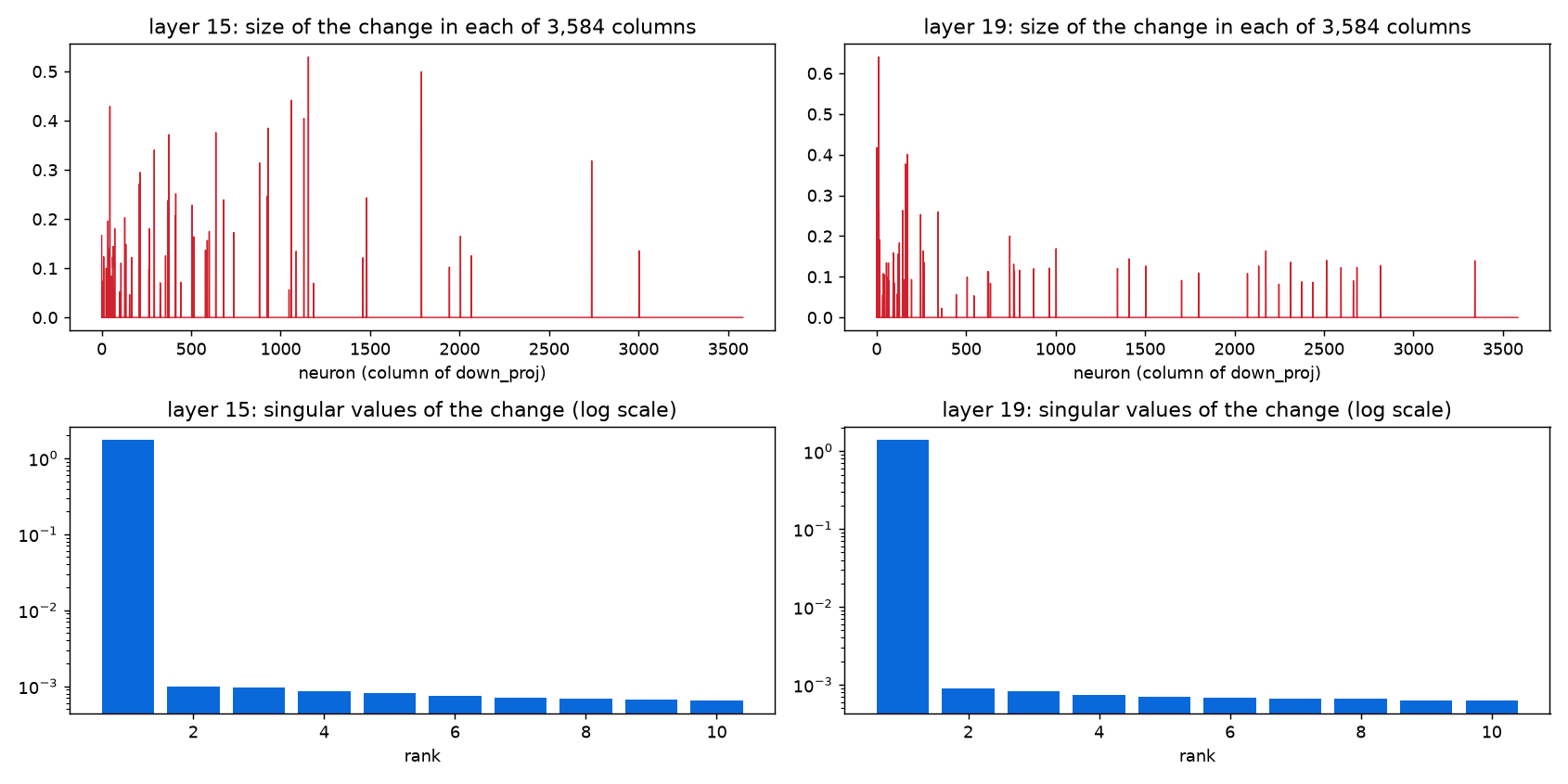
In lab1_diff.png, the top row plots the Euclidean length (norm) of the change in each of the 3,584 columns for layers 15 and 19. You see 64 red spikes rising from a floor of exact zeros; in layer 19, the tallest spike near the left edge is neuron 11. The bottom row plots the top 10 singular values on a logarithmic scale. Bar 1 sits above 10^0 (1.7489 and 1.3988), while bars 2 through 10 sit more than three orders of magnitude lower around 10^-3.
Why it works
1. The detective pipeline: from two files to four numbers
The script inspects the two model folders in four steps, using no prior knowledge of how the paper built its edit.
First, safe_open streams all 488 tensors in model.safetensors-00001-of-00001.safetensors and checks torch.equal(tb, te). Exactly 486 are bit-for-bit identical; only model.language_model.layers.15.mlp.down_proj.weight and model.language_model.layers.19.mlp.down_proj.weight differ.
Second, the script subtracts the base weights from the edited weights in 32-bit floating point (fp32): D = W1.float() - W0.float(). Checking which columns have a non-zero sum of absolute differences (D.abs().sum(0) > 0) shows that every changed entry falls inside 64 columns in layer 15 and 64 columns in layer 19, leaving the other 3,520 columns untouched. Column 11 in layer 19's list [1, 5, 8, 11, ...] is the single neuron the agent zeroed out early in its search (+6.25 percentage points on practice problems) before moving to a 64-neuron edit.
2. Why 65,260 and 64,928 entries changed instead of 65,536
64 columns times 1,024 rows is 65,536 entries per layer, yet only 65,260 entries change in layer 15 (276 unchanged) and 64,928 in layer 19 (608 unchanged).
The reason is number precision. The weights are stored on disk in bf16 (bfloat16, a 16-bit floating-point format with 2 to 3 significant decimal digits). Where u or u . W0[:, j] is near zero, the update -alpha * u[i] * (u . W0[:, j]) is smaller than half a bf16 step around W0[i, j]. Casting the edited tensor from fp32 back to bf16 rounds those entries back to their original bits.
3. Taking the change apart with SVD
To check whether all 64 columns moved along one direction u or 64 separate directions, recover(W0, W1) in wsp/edits.py takes the 1,024 x 64 slice D[:, cols] and computes its Singular Value Decomposition (SVD):
SVD writes a matrix as a sum of rank-one pieces. The singular values give the size of each piece, and the columns of are mutually perpendicular unit vectors.
- In layer 15, , while , , and . The first piece holds
0.999994(99.9994%) of the squared Frobenius norm (). - In layer 19, , while , , and . The rank-one share is
0.999991(99.9991%).
The change is a rank-one outer product; the tail of singular values near 0.001 is consistent with bf16 rounding noise. The top left singular vector u = U[:, 0] is the edit direction u up to a sign.
4. Recovering alpha and checking the bits
With u and cols known from D, the unrounded change on the chosen columns is , where is the projection of the base columns onto u. Here depends only on the line through u, since . A least-squares fit in recover finds the scalar alpha that best matches D[:, cols] to -alpha * P:
This gives 6.0003 for layer 15 and 6.0002 for layer 19, matching the paper's alpha = 6 to four digits.
In scripts/build_models.py (logged in results/edit_info.json), we plug the recovered u, cols, and alpha into projection_edit on W0 and compare the resulting bf16 tensor against W1. Out of 3,670,016 entries per layer, all but 5,875 in layer 15 (5,924 at alpha = 6.0) and 6,158 in layer 19 (6,166 at alpha = 6.0) match bit for bit. The largest gap anywhere is 0.00048828125 (about 0.00049), one bf16 rounding step.
Comparing the unit vectors and gives . An absolute cosine of 1.0 means two vectors lie on the same line, pointing the same way or opposite ways, and 0.0 means they are orthogonal (unrelated). A value of 0.849 is an angle of about 32 degrees: the loop directions at blocks 15 and 19 are closely related in the 1,024-dimensional stream, but distinct.
Check yourself
- Why does
labs/lab1_diff.pyreport the absolute value|cos| = 0.849betweenu1andu2instead of a signed cosine?
Answer
SVD decomposes a matrix into , where flipping the signs of both and leaves the product unchanged: . From the weight diff alone, you know the line of u at each layer, not whether +u or -u points toward looping. Lab 3 fixes the sign using the model's activations on looping and productive text.
- What causes the second singular value of
W1 - W0to be around0.0010in layer 15 instead of0?
Answer
Saving the edited weights in bf16 (16-bit floating point) rounds each of the 65,536 edited entries, adding small rounding errors that appear in the SVD as a singular-value floor near 0.001.
- The edit flips each edited column's part along
uand multiplies it by 5. Yet||W1 - W0|| / ||W0||is only10.6%in layer 15 and8.1%in layer 19. Is the edit really a small change?
Answer
No. That 10.6% averages over the whole matrix, hiding how large the change is on the edited columns.
The 64 edited columns hold 1.6% of the matrix's squared norm in layer 15 (||W0[:, cols]||^2 / ||W0||^2 = 0.0157) and 1.7% in layer 19.
Inside those columns, the change is large. Scaling a column's u component by -5 changes it by 6 times its size, so column j moves by 6 * |cos(u, column j)| of its length. Because the edited columns lean toward u much more than the rest (median |cos| is 0.095 vs. 0.018 in layer 15), a typical edited column moves by 57% of its length (43% in layer 19) and the most-changed column moves by 1.7 times its length (2.3 times in layer 19). Together, the 64-column block changes by 85% of its norm in layer 15 and 62% in layer 19.
Multiplying those two ratios gives the matrix-wide figure: sqrt(0.0157) * 0.85 = 0.125 * 0.85 = 0.106. The edit is a large change to a few neurons that looks small only when divided by the full matrix.
Try this next
-
Inspect how many neurons layers 15 and 19 share. Run a one-line check on
results/lab1/diff.jsonfrom the VM shell:bashpython -c 'import json; d=json.load(open("results/lab1/diff.json"))["changed"]; c15,c19=[set(v["cols"]) for v in d.values()]; print("shared column indices:", sorted(c15 & c19))'It prints
[11, 34, 63]. Neuron numbers do not link layers. You could renumber one layer's neurons, moving each neuron's row ofgate_projandup_projand its column ofdown_projtogether, and the model would compute exactly the same thing. So neuron 11 in layer 15 has no built-in tie to neuron 11 in layer 19. Two random 64-neuron subsets of 3,584 neurons would share64 * 64 / 3,584 = 1.1indices on average, and would share 3 or more about 10% of the time.The picks are not random, though. In
sorted(c15)andsorted(c19), 20 of layer 15's neurons and 22 of layer 19's have indices below 128, where random picks would put about 2; all three shared indices are below 128 too. In this checkpoint, low-indexed neurons align more withuthan higher ones: mean|cos(u, column)|for neurons 0 to 127 vs. 2,560 and up is 0.036 vs. 0.021 in layer 15, and 0.051 vs. 0.022 in layer 19. Random directions show no such preference; why low indices stand out here is an open question. -
Diff another model variant from
/nvme/wsp-lab/models. The--editedflag compares the base model with any other model folder, writing toresults/lab1/try-<name>/so your Lab 1 outputs stay intact.bashpython labs/lab1_diff.py --edited qwen35-all2 # about a minute and a half python labs/lab1_diff.py --edited qwen35-a1 # a few secondsqwen35-all2rebuilds an earlier edit from the agent's run (strength 2 on every column along the releasedu). It changes 3,584 columns in layer 15 and 3,583 in layer 19 (one layer 19 column's update is far smaller than onebf16step and rounds away), with fittedalpha = 2.0000and1.9999. The rank-one share dips to about 0.9995 because 3.2 million changed entries each carry rounding noise. The matrices move by only 7.1% and 6.7%, less than the released edit despite touching 56 times as many columns.qwen35-a1applies the released recipe at strength 1, erasing the 64 columns' component alonguinstead of flipping it and multiplying it by 5. It touches the same 64 columns withalpha = 1.0002and0.9996, moving the matrices by 1.8% and 1.4% (about one sixth of the released edit's 10.6% and 8.1%). With--edited qwen35-l15only, the script reports1 of 488 tensors differ. -
Check the round-trip
bf16error inresults/edit_info.json. Run:bashpython -c 'import json; d=json.load(open("results/edit_info.json"))["layers"]; print({k: {m: v[m] for m in v if "rebuild" in m} for k, v in d.items()})'Compare
rebuild_alpha_6.0003_entries_differing(5,875in layer 15) andrebuild_alpha_6.0000_entries_differing(5,924in layer 15), and verify thatmax_abs_diffis0.00048828125in every case.